Projects & Collaborations · Mccreedy Studio, Zurich
AI Animations
Each AI animation produced by Mccreedy Studio is entirely unique— the MCC Ai programme is all vertical integrated, a pioneering achievement in the art world. For the first time, original oil paintings have been meticulously transformed into animations, with every brushstroke brought vividly to life through the expertise of the Mccreedy Studio AI team. This innovative process marks a significant milestone, as it is the first of its kind to merge traditional oil painting with advanced animation technology.
Each ultra high-definition AI animation is singular, secured with blockchain technology via the Origyn Foundation—dedicated to ensuring the highest standards of authenticity, privacy, and data protection in collaboration with Mccreedy Studio. This guarantees that every AI animation is as original and exclusive as a traditional oil painting, with only one existing in the world. The resolution is so exquisitely detailed that these works can be projected onto large-scale buildings without any loss of clarity or depth.
Under the visionary leadership of founder Conor Mccreedy, Mccreedy Studio remains committed to preserving the craftsmanship and integrity of traditional oil painting, while simultaneously embracing cutting-edge technology to add unprecedented dimensions and depth to the art form. This harmonious blend of ancient technique and modern innovation elevates the evolution of art to new heights.
Furthermore, the technology behind these works is so advanced that it enables Mccreedy and his team to experiment in a creation of biometric AI artworks. In these pieces, Mccreedy’s oil paintings of animals come to life, responding dynamically to the presence, temperature, and energy of viewers standing before them. This interactive experience represents a groundbreaking fusion of art and technology, offering an entirely new way to engage with and appreciate fine art.
The Mccreedy Studio’s AI animations are not only a technological breakthrough but also a transformative development in the world of art, redefining the boundaries of creativity and originality.
This iconic AI artwork is derived from the original oil painting in which the artist himself speaks in Italian, introducing key points about his solo exhibition, “Imperial Blues”—a powerful series of imperial oil portraits by Mccreedy. In this AI piece, we hear Mccreedy discuss the famous emperor who ruled Rome from the island of Capri, and who also inspired the name of his firstborn son, Tiberio Blue. The exhibition transforms the majestic cloister of the Certosa into an evocative gateway to the New Archaeological Museum of Capri. The paintings establish a silent yet intense dialogue with the works on display, as if introducing visitors to the heart of the museum and creating a bridge between archaeology, history, architecture, and contemporary art. Blue, the iconic color in Mccreedy’s work, evokes the surrounding sea and is imbued with spiritual meaning, amplifying the depth of both the visual and symbolic experience.
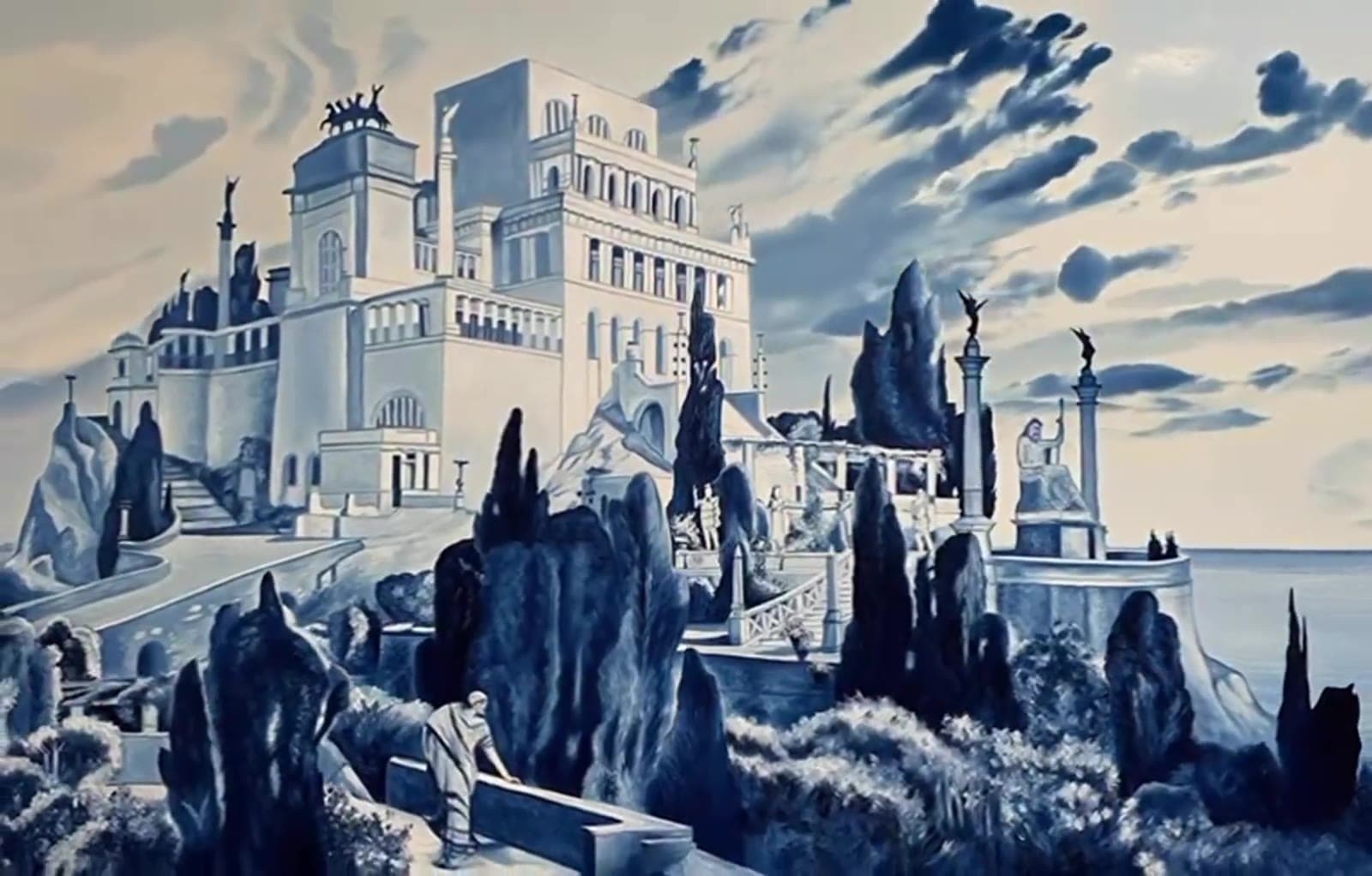
“This oil painting is a fantastical reinterpretation of Villa Jovis, the legendary retreat of Emperor Tiberius, based on the work of Carl Weichardt (1846–1906). Villa Jovis is the largest of the twelve Tiberian villas on Capri mentioned by Tacitus. The entire complex, spread across several terraces with a height difference of about 40 meters, covers an area of approximately 7,000 square meters. Although the remains—eight levels of walls and staircases—offer only a glimpse of the magnificence the building must have once had, recent reconstructions have revealed that the villa stands as an extraordinary testament to early Imperial Roman architecture”.
“Questo dipinto a olio è una reinterpretazione fantastica di Villa Jovis, il leggendario rifugio dell’imperatore Tiberio, tratta da Carl Weichardt (1846-1906). Villa Jovis è la più grande delle dodici ville tiberiane a Capri menzionate da Tacito. L’intero complesso, distribuito su diverse terrazze con un dislivello di circa 40 metri, si estende su una superficie di circa 7.000 metri quadrati. Sebbene i resti — otto livelli di muri e scale — offrano solo un accenno alla magnificenza che l’edificio doveva avere in passato, recenti ricostruzioni hanno mostrato come la villa rappresenti una straordinaria testimonianza dell’architettura romana dei primi anni dell’Impero”.
This AI artwork has been transformed from the original oil painting and serves as a reconstruction of what the Villa Jovis would have looked like over 2,000 years ago—the palatial main villa where Emperor Tiberius lived and ruled the Roman Empire. Mccreedy, together with his AI team, is the first artist in the world to literally transform original oil brushstrokes into AI animation. As you view the paintings on display and enter the historical Archaeological Museum of Capri—just before the Blue Grotto installation—you will also encounter an architectural concept within the museum, offering a unique perspective on the Villa Jovis.